Elizabeth
Martha Anne Browne (but known as Pattie) was born at Camp Hill,
Tullamarine Victoria on 1 January 1863. She was the third of the eleven
children of Hugh Junor Browne and his wife Elizabeth (née Turner). She later married Alfred Deakin, sometime Premier of Victoria, and Prime Minister of Australia.
Throughout her married life, Pattie devoted herself to her
family and charity work, especially in the area of child welfare. She encouraged her three daughters to live a
life of service to others.
For a listing of her philanthropic work, see the Australian
Women's Register.
Jane McMillan and Pattie Deakin (in a hat) with the
volunteers of the Soldiers’ Refreshment Stall. The conditions are fairly rudimentary with a caanvas awning and the windowhatches the only shelter in the event of rain. Photo: Voluntary
War Workers Record, Australian Comforts Fund, 1918.
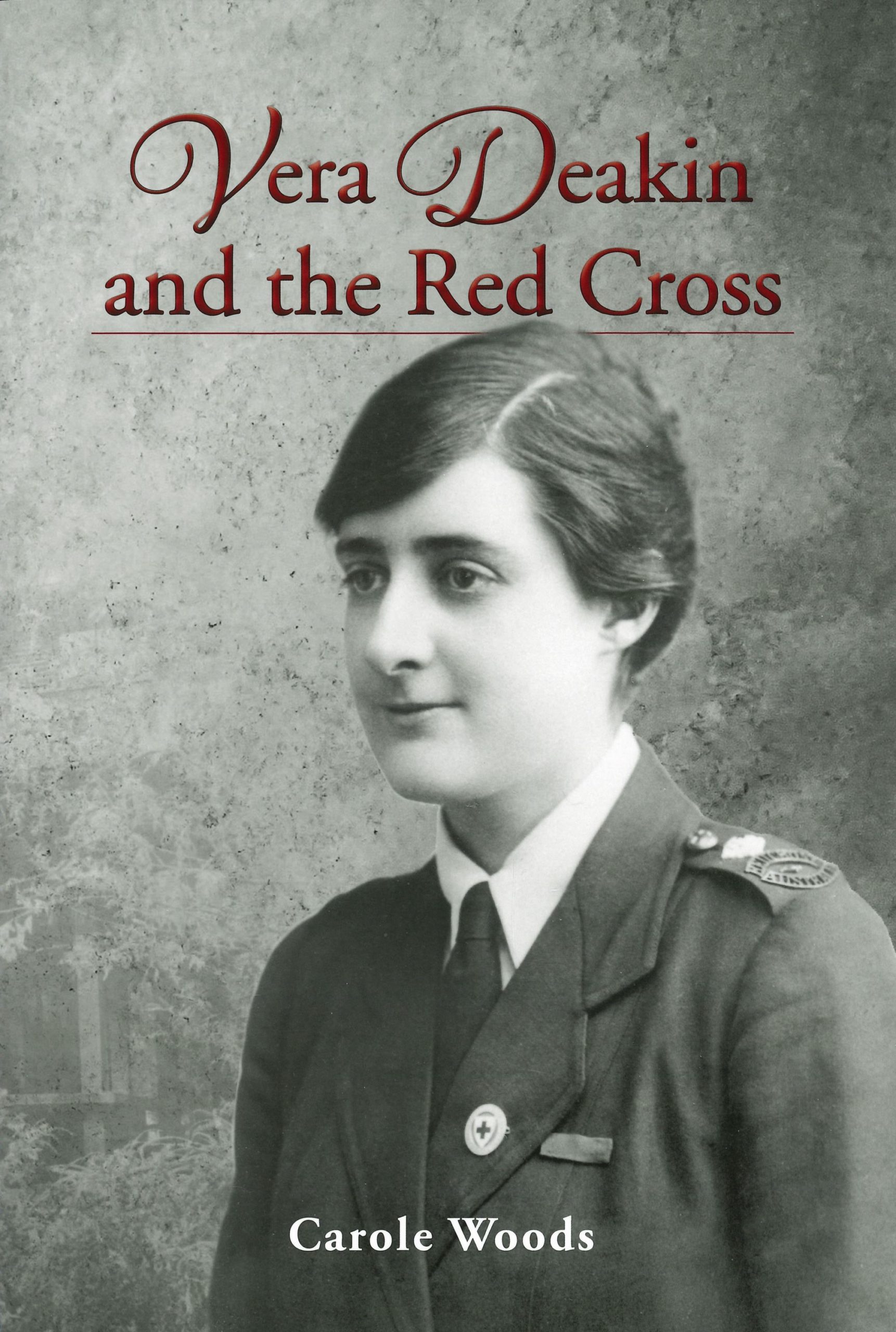
Vera
Deakin and the Red Cross, by Carole Woods, was published by the Royal
Historical Society of Victoria in 2020.
While reading this book I was interested in the reference to the Anzac
Buffet, and most particularly just exactly where it was in St Kilda Road. It required a little bit of digging, but now
I know.
When the war began in 1914, the Australian Army put its
efforts into equipping and training their recruits for war, but it was the
women of Australia who threw themselves into providing comforts and morale
boosting for young men separated from their friends and family. Though the troops were surrounded by young
men similar to themselves, they could be
lonely for their wives and girlfriends, mothers and sisters. The women of Australia understood this and
with a will they threw themselves into providing home comforts for the
men.
The women also excelled at seeing a need and working out a
way of filling that need without the support of a huge organisation around
them. The Soldiers’ Refreshment Stall,
later called the Anzac Buffet, is one example of a need met by a group of women
without a formal organisation. Leadership was provided by older women, self-selected
largely through class and status, and the rest generally formed a supportive
group around them with no formal structure required, only a willingness to work
hard and fill a need.
When men who had returned from overseas began congregating
for appointments at the 5 Australian General Hospital (5AGH) in St Kilda Rd,
often waiting for lengthy periods to be seen, the need was perceived for hot
drinks and a meal to sustain them during their long waits and travel time at
both ends of the appointment. The men
were highly appreciative of the services provided by the women, and all for the
cost of only one penny.
The 5AGH was located in the newly completed Police Hospital.
Before ever having admitted a patient, the Police Hospital was taken over by
the Army to provide for soldiers yet to embark and also by wounded returning
from Gallipoli. The first patients were admitted in March 1915.
A news
article described this drawing: “The Building elevation shown above is that of
the new police hospital which is in course of erection upon a site on the
corner of St Kilda road and Nolan-street, which was formerly part of the old
Immigrants Home property.” (Argus,
20 June 1914).
No. 5 Australian General Hospital
(Base Hospital) Melbourne. F C Hawker, p 6.
The hospital faced Nolan Street on the north side, now
renamed Southbank Boulevard. St Kilda
Road passes in the foreground. It
reverted to a Police Hospital in 1920.
The Police Hospital from a drawing of the entire
Police Depot in St Kilda Rd.
See The Heritage-Listed Old Police Hospital is Born Again.
Former Prime Minister Alfred Deakin had accepted an
invitation to form a delegation to visit the USA in January 1915, and despite
his daughter Vera being anxious to find a way to serve the war effort, she was
obliged to accompany her parents to California.
Pattie, his wife, and Vera Deakin had been original members of the
British Red Cross organising committee in Melbourne in 1914, but left the
committee when they travelled overseas with Alfred. Both of the women were accustomed to
leadership roles, so on their return
they had to find a new activity rather than appropriate their former positions,
now occupied by other women. The Australian
Red Cross was providing workers in the kitchens at the 5th
Australian General Hospital (5AGH), and
it might have been their suggestion that there was a need for a
refreshment service for the men who had long waits to see doctors and other
health professionals.
Vera Deakin worked with her mother and Jane McMillan in the
establishment of the Soldiers Refreshment Stall, but on 21 December 1915, Vera
and her friend Winifred Johnston left Melbourne on a ship bound for Cairo, to
begin her important war work with the Australian
Red Cross Wounded and Missing Enquiry Bureau.
The Deakins arrived home in early July 1915. On 29 August 1916 The Argus reported
that the first birthday of the Soldiers’ Refreshment Stall had taken place on
the previous day, implying that the Deakin women had taken less than two months
to set up and commence their work in 1915. There were formalities to go through – permission from the authorities at the
5AGH, a tent to work in, some basic equipment to assemble and the first
donations of tea, coffee, cocoa and bread, cake and appropriate provisions for
soup, and a team of volunteers to operate the stall seven days a week. They kept this up for four solid years, with
the work building from 4,000 per week in 1916
to an average of 1,000 “serves” per day in 1919. (The Herald, 11
Nov 1919, p 1).
The Stall served hospital
outpatients, drivers, men from the camps, orderlies and all soldiers who
had a need of it. Ten and later 15
volunteers turned up each day to run the stall. The group photographs show thirty-six
and forty-eight volunteers respectively, and thirty-five are listed
individually in the Voluntary
War Workers Record, Australian Comforts Fund, 1918. Between 400 and 500 volunteers assisted
throughout the period of its operation, and 130 names were on the roll in 1919.
(The Herald, 11 Nov 1919, p 1).
From the Ladies Letter, Punch, 4 May 1916:
“The Base Hospital Soldiers' Refreshment Stall celebrated
Anzac Day by entertaining over two hundred overseas "Anzac" men, presenting
each guest with packets of cigarettes,
sweets, and matches. There was no speechifying or boresome
formality about the affair—just a homely, cheery greeting characteristic of this pleasant "corner"
run by the "Serve You Right Sisters," as the volunteer- caterers at the S.R.S. are
affectionately dubbed by their khaki customers. Each arrival was just enjoined,
in greeting to "remember the day, and what it commemorates” and, indeed,
the majority, of those present, with limp, hanging, empty sleeves, shaded eyes
and pathetic bandages, had every reason to remember.
This "corner," by the way, is kept so busy
now that it requires an average "of
ten helpers a day. There is no committee, no board, no red tape. Practically
every suburb is represented among the helpers, among whom exists a
wonderful esprit de corps and absence of friction. Over 900 men per day are fed
and "mothered" very often, or a mean average of 4000 per week.
Supplies and cheques just flow in without any necessity for canvassing or
pleading on the part of the organisers — not in huge, spasmodic lumps and
amounts, mind you. There is just that
knowledge among the S.R.S. that they know where to turn for support ; a regular
fifty pounds of tea, for instance, keeps the caddy replenished from one firm ;
so many pounds of cake per week arrive from another ; and so on. A leading Prahran
emporium the other day handed in a cheque for £25, saying that was only the
beginning of what the employes intended to do as a recognition of the fine work
being done.
"By their works ye shall know them," and the
gratitude of the soldiers who have been administered to, and of their relatives
and friends, is constantly being signified in a variety of ways. One soldier—a
baker by trade—sends along his "thank you" every week in the form of
a trayful of pastry cook's goodies. The mother of one soldier who was shown
kindness by these volunteers tried to express her gratitude by offering little
gifts to the chief ministering angel. This was gently declined, with the
explanation that other soldiers who were not able to afford such presents might
be made to feel unhappy; but if "Mum" liked to send along some scones
or something they would be very welcome. Now, with frequent regularity, a package
of home-made cakes, scones, etc., arrive at the buffet from this grateful
"Mum." In addition to the hundred-and-one little services which the
workers in this "corner" are able to do, such as sewing on buttons,
writing letters (for those, alas ! incapacitated), interceding with authority,
helping through inquiries, comforting relatives, etc., a regular "Returned
Soldiers' Aid Fund" has become established.
Temporary loans for small amounts are advanced to
those who need them. Poor Billy Khaki is so often "stoney," awaiting
pay arrears—goodness knows why and how !
This temporary accommodation is given, with discretion, with common-sense
judgment, but without cold official inquiry, without red tape, without even
hesitation" as to its being "deserving." And how it is
appreciated ! In nine cases out of ten all such advances are returned in due course.
And as for the tenth—well, what are we all supposed to be doing, and thinking,
and talking of, and bragging about, if it is not helping soldiers in need? Another excellent movement instituted is for the
provision of suits of civilian clothes for discharged invalids. A soldier is given
one outfit by the Government when he doffs his khaki. If that gets wet or
damaged he can very seldom afford to buy another. Husbands and friends of this
helpful sisterhood are only too glad to contribute suits for this, purpose, particularly duck and linen, outfits for on
board ship for those discharged men who have to return to England”. (Punch, 4 May 1916, p 32.)
The soldiers', new refreshment stall at the base hospital,
St. Kilda road, was opened on November 30 by the acting State Commandant,
Brigadier-General R. E. Williams. The pavilion was built at the expense of the
Defence department in order to provide better accommodation for carrying on the
work than the old structure afforded. The new stall has been christened the
"Anzac Buffet," and in it returned soldiers are provided with refreshments at a nominal
cost. The buffet is conducted by a number of patriotic sympathetic ladies, who give
their services, voluntarily. After Brigadier-General Williams had explained the launching
of the movement two and a half years ago by women eager to serve their country
in any capacity, Mrs Alfred Deakin (directress)
responded, thanking the Defence department
for the gift of the pavilion, which would greatly assist in the work they
were devoted to, at which announcement the soldiers cheered enthusiastically.
Luncheon was subsequently served, and amongst those present were Brigadier-General
and Mrs Sellheim, Mr. Alfred Deakin, Colonel F. D. Bird, Major and Mrs.
Courtney, Colonel G. Cuscaden, Lieut.-Colonel Pleasants, Matron C. Milne, Mr. T
Trumble, Mr. F. Gates, and others. (The Australasian, 8 Dec 1917, p 41)
At the same time as the improvement in accommodation and
name change for the buffet came also some smart uniforms for the women.
The large band of voluntary workers, for they number
over a hundred, who help at the soldiers' refreshment stall on St. Kilda road, have
blossomed out in smart uniforms of dark brown covert coating coats and skirts piped with
red. They are very proud of their new pavilion, which Brigadier-General Williams described
as "being quite ornate," and it is in comparison with the little building in which
they first started. Fourteen women with a matron attend every day, and serve refreshments
to returned soldiers and men on final leave only, and they have carried on their work
without ostentation or desire for publicity for two and a quarter years. As this is, I believe,
the first group of women to don a set style of dress, no doubt others will follow suit, and so we
may have for all voluntary workers a recognised uniform like the Women's Auxiliary Army
Corps in England. (Table Talk, 20 Dec 1917, p 31.)
On 1 August 1918 the Punch featured the Anzac
Buffet in a page of photographs, by F W Tolra:
1 A
group of buffet workers. (Looking very smart in their new dark brown tops and
skirts with red piping.)
2 Watching the recruits pass. (Outside their new tin pavilion.)
3 The Army and Navy Meet.

4 Sandwich cutters hard at work.
5 A corner at lunchtime – Anzacs all! (Rather more spacious than the original refreshment
stall)
6 Some of the boys. (“Our
four years' service here has been the greatest privilege of our lives.”
Pattie Deakin and Jane McMillan. )
In 1918 the Australian Comforts Fund published a small book entitled Voluntary War Workers Record to raise money for the comforts fund. In this is a very engaging article from Philip Ray (most likely a pseudonym for Ray Philips, who appears in the list of Buffet volunteers included) describing the activities and atmosphere in the Anzac Buffet on an average day.
The closing of the Anzac Buffet was announced in August 1919, and many were the tributes for the kindness and hard work of Mrs Deakin, Mrs MMillan and the volunteers of the Buffet. A typical tribute was paid by a returned Sergeant:
ANZAC BUFFET CLOSES
SERGEANT WITH 9 CHILDREN PAYS
HEARTFELT TRIBUTE
After four years of useful service the Anzac Buffet
at
the Base Hospital closed today, and the speeches
which were delivered at
a brief ceremony indicated
the high place which the institution has won
in the
hearts of the diggers. '
"I am just out of hospital and I have nine kids,
who are growing up now, thank goodness,"
declared a burly sergeant,
wearing the Anzac
rosette. "The humble little 'browns' which I
pushed across the
counter here were a great
help to me, until I got my settlement. It has
been
wonderful to the boys." His impromptu
speech won more applause than any of the
more formal expressions of approval.
Brigadier-General Brand, the State
Commandant,
sketched the story of the
buffet from its inauguration in a bell tent,
through
the stage when it was housed in
a shack, to its work in its present
building.
He paid a tribute to "those devoted ladies,"
Mrs A. Deakin, Mrs McMillan
and their
co-workers, and mentioned that the
average number of meals served
in a day
was 1000. The buffet had been supported
entirely by private
subscription, and would,
in future, continue as a canteen for patients
in the
hospital.
Senator Russell, Acting Minister for Defence,
said
that the four years of hard work which
had been carried out by the workers at
the
buffet showed a spirit which would, in the
male gender, have found
expression at the
front. Mr
Groom, Acting Attorney-General,
said
that the name borne by Mrs Deakin
would live for ever in Australia, because
it
stood for all that was best in Australian
national life. The name of Deakin
was
one of the greatest not only in the history
of the Commonwealth but of the
British
Empire. The lady who had stood by Mr
Deakin through it all was
with them today,
and he had heard that when the statesman
was in
England she had been called the
"Queen of Australia." It had been
her
pleasure to work for the soldiers who had
made Australia the nation of which
her
husband had always dreamed. (Applause.)
Mr Herbert Brookes, in responding on behalf
of Mrs
Deakin and her co-workers, said that
it was one of the “greatest
distinctions” of
his life that he was her son-in-law. The ladies
had felt it was a
privilege to wait upon the
diggers, and, as most of them had relatives
at the
front, it was heart-ease to them.
(Cheers.)
In response to repeated calls, Mrs Deakin
said that
they had felt it a privilege to wait
upon the soldiers. She and Mrs McMillen
had learnt to love their workers in a way
they would not have thought
possible.
The Diggers had set a splendid example,
and they had tried to live up
to it.
(The Herald, 4 Aug 1919.)
Although Herbert Brookes waxed lyrical about it being one
of the greatest distinctions of his life that he was Pattie Deakin’s
son-in-law, he rewarded her by implacably opposing her daughter Vera’s marriage
to Tom White, as if it was his right to choose Vera’s life partner. He had supported Vera in her decision to
travel to Cairo to help in the war effort, and supported her with funds to help
with her living expenses, but apparently
felt this gave him rights as to her deciding about her marriage. Vera married Tom White anyway, but his opposition caused great distress at the
same time as her father was dying.
In 1923 The Herald noticed the final passing of the
old Anzac Buffet:
End of Anzac Buffet
THE little Iron shed on the St. Kilda road, next to
the police hospital, where for the past two years
a band of kind-hearted
women have provided
a free mid-day meal to any Digger who cared
to come
along, has gone, and with it despair
will re-enter the hearts of some
distressed
ex-soldiers this winter, when they are right
"up against it"
once more. It was only with
the utmost difficulty that the organisers were
able to
carry on this Anzac Buffet in its later
existence. Funds became lower and lower,
and every week, despite the good work
which the buffet was doing, public
apathy
increased in direct ratio to the decrease
in its monetary support. Finally the
land
on which the shed stood was required for
rebuilding, and now only a fence
marks the site.
(The Herald, 5 Feb 1923, p 6.)
After the Anzac Buffet
closed, equipment was donated to the Returned Soldiers and Sailors Imperial League
(RSSIL) for their clubrooms.
The two women who were most synonymous with the Anzac Buffet in
Melbourne, Pattie Deakin and Jane McMillan had, however, bowed out in 1919,
thanking the Diggers:
ANZAC BUFFET.
TO THE EDITOR OF THE ARGUS.
Sir, In closing the Anzac
Buffet we should like to
take the opportunity of thanking the "diggers"
who have visited us since we
opened in 1915 for
their chivalrous behaviour in all circumstances.
Our four years' service
here has been the
greatest privilege of our lives. We wish them
all the
best of good fortune in the years to
come on behalf of the women of the Anzac
Buffet
PATTIE DEAKIN.
JANE McMILLAN
(The Argus, 10 Nov 1919, p 7)
Pattie’s husband Alfred
Deakin, former Prime Minister of Australia, had died on 7 October 1919, just a
month before this gracious farewell from the two ladies. Jane had lost her only child in September
1917, but somehow had drawn herself together and returned to work at the Anzac
Buffet.
Most diggers understood that the women of Australia had their own
burdens to carry – sorrow, grief, anxiety, and often found on their return to
Australia, that their families had been badly affected, with their parents or
grandparents carried off by the constant stress of having their sons away, or
the death of cousins and nephews, or deaths of sons of their close
friends. The war left a shadow on
Australia for many decades.
I need to disclose that I am a member and volunteer of the Royal Historical Society of Victoria.
SOURCES
Trove
.jpg)


.jpg)